
Guide
What Are Prediction Markets and How Do They Work?
What are prediction markets? How event contracts pay $1, why prices read as odds, the fees, who can use which venue, and how markets settle.
 By Julian Stafford, Co-Founder, Surgence Labs · 11 Oct 2026 · 9 min read
Prediction markets are exchanges where you buy and sell contracts on whether a future event will happen, and each contract pays $1 if it does and nothing if it does not. The price of a contract, between 1 and 99 cents, works as the market's estimate of the probability, which is why people watch prediction markets as well as trade them. This guide covers how they work, what they cost, who can use which venue, how markets settle, and the prediction market campaigns running on TraderComps now.
How a Prediction Market Works
Every market asks a question with a fixed end, such as whether a central bank will cut rates at its next meeting or which team will win a match. You buy a "yes" or a "no" contract on it. When the event is decided, the winning side pays $1 per contract and the losing side pays nothing. Robinhood's help centre puts it plainly: all event contracts settle in cash, with a maximum payout of $1 and a minimum of $0 (Robinhood).
You do not have to hold until the end: you can sell at the current price before the result is known. The CFTC, the US derivatives regulator, describes these products as contracts where participants buy and sell based on whether stated events occur (CFTC). In US law they are derivatives, which is why "event contracts" is the regulated name and "prediction market" the everyday one.
Prices as Probabilities
Because a contract pays $1 or nothing, its price reads as a probability. Robinhood's example: a contract at $0.70 implies roughly a 70% chance the outcome occurs, and the "no" side trades near $0.30 (Robinhood).
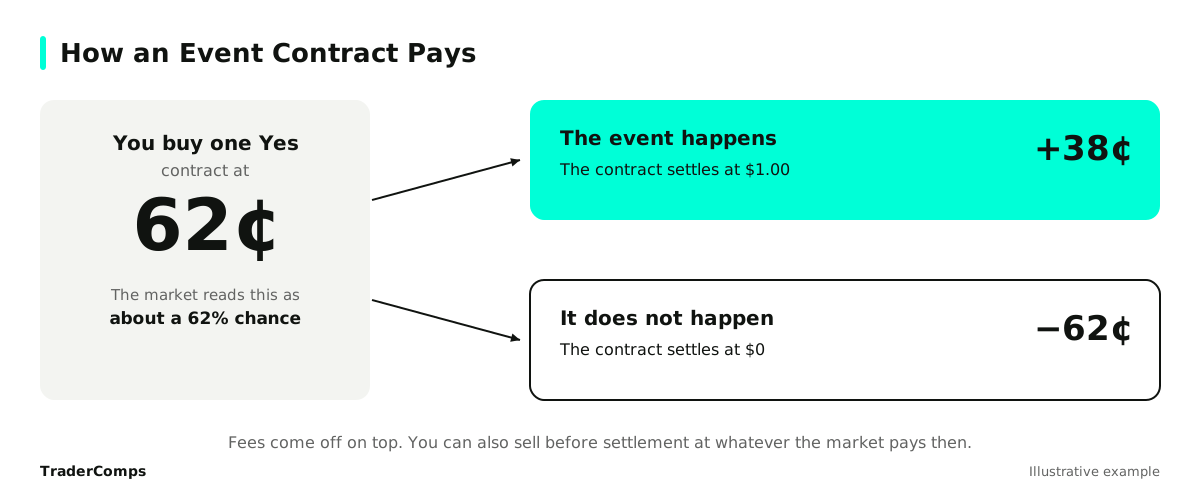
Your profit is the gap between what you paid and $1, minus fees. Buy 100 "yes" contracts at 40 cents and you spend $40. If the event happens you receive $100, a $60 gain before fees. If it does not, you lose the $40. Crypto.com's help centre states the same limit: if you are wrong, you lose what you paid to open the position and nothing more (Crypto.com).
Treat the probability as rough: fees, spreads and thin trading all move prices away from a clean forecast.
How Venues Make Money
Prediction markets earn mainly from trading fees, and most of them publish a formula rather than a flat rate.
- Kalshi charges a taker fee of 0.07 times the number of contracts, the price and one minus the price, rounded up. It is largest at 50 cents, about 1.75 cents a contract, and smaller near 1 or 99 cents. Its makers pay only on markets that carry a maker fee, and there is no settlement fee (Kalshi fee schedule). Kalshi describes this as a transaction fee on the expected earnings of the contract (Kalshi).
- Crypto.com publishes the same taker formula for its US prediction trading, a maker fee of 0.0175 times contracts, price and one minus price, and no fee at settlement (Crypto.com).
- Polymarket charges takers only, using a rate that varies by category, from 0.04 for finance and politics to 0.07 for crypto, with geopolitics markets fee-free. Makers pay nothing and receive part of the fees back as rebates (Polymarket).
- Limitless charges takers only: 0.40% to 3.00% on buys and 0.42% to 1.50% on sells in its order-book markets, and a flat 0.40% in its AMM markets (Limitless).
- Brokers add their own layer. Robinhood offers event contracts through KalshiEX, ForecastEX, Rothera and the North American Derivatives Exchange (Robinhood). It charges a commission it says never exceeds $0.01 a contract, plus the exchange's own fee (Robinhood).
The spread is the other cost. On an order book, the price to buy is above the price to sell, and the difference goes to whoever is quoting, usually market makers. Venues pay to keep those quotes tight: OKX's Event Contract Liquidity Rewards Program budgets up to 48,000 USDT a month for market makers (OKX).
Regulated Exchanges and On-Chain Markets
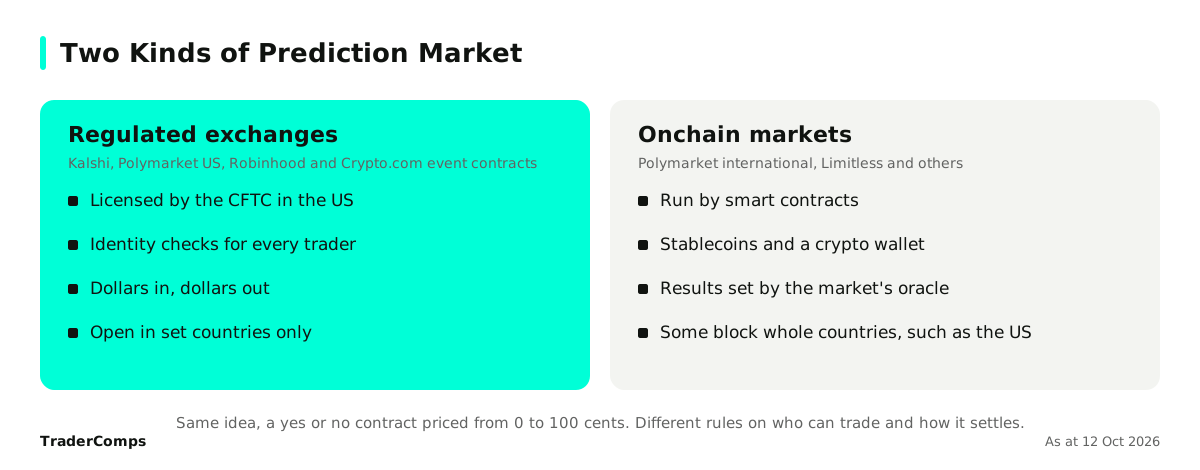
There are two broad models. Regulated exchanges hold your dollars, verify your identity and answer to a regulator. On-chain markets run on a blockchain, settle in stablecoins and set their own access rules.
| Venue | Model | Regulator on record | Who can trade | Taker fee published |
|---|---|---|---|---|
| Kalshi | Exchange (designated contract market) | CFTC, since November 2020 | 18 and over; US and many other countries under its Member Agreement | Yes, price-based formula |
| Polymarket | On-chain order book on Polygon, plus a separate US exchange | CFTC for Polymarket US (QCX LLC) | International platform blocked in some countries, including Australia; Polymarket US is a separate exchange | Yes, by category |
| Crypto.com | Exchange arm in its app | CFTC, through Crypto.com Derivatives North America | US only | Yes, price-based formula |
| Robinhood | Broker routing orders to exchanges | Routes to exchanges including KalshiEX (CFTC) | US residents, 18 and over; not all states | Commission up to $0.01 plus exchange fee |
| Limitless | On-chain order book and AMM on Base | None recorded | Trading prohibited in the US, China, Ontario and Alberta | Yes, takers only |
Sources: the CFTC designated KalshiEX as a contract market on 4 November 2020 (CFTC) and QCX LLC, now Polymarket US, on 9 July 2025 (CFTC). Crypto.com's prediction trading is offered by Crypto.com Derivatives North America under CFTC oversight (Crypto.com). Kalshi's eligibility is from its help centre (Kalshi), Robinhood's from its event contracts overview (Robinhood) and Limitless's from its terms (Limitless).
US regulation is still moving. The CFTC asked for public comment on prediction markets in March 2026 (CFTC), proposed a framework in June for reviewing event contracts that involve gaming and other listed activities (CFTC), and in April sued Arizona, Connecticut and Illinois to assert its exclusive jurisdiction over prediction markets (CFTC).
Who Can Use Which Venue
Where you live decides most of this.
- United States. Kalshi, Polymarket US and Crypto.com's prediction trading are the regulated routes, and Robinhood offers them inside its app. State rules still bite: Robinhood says Maryland and Nevada residents cannot trade sports event contracts, and Michigan residents cannot open new ones from 9 September 2026 (Robinhood). Limitless prohibits trading from the US.
- Great Britain. The Gambling Commission says a prediction market falls within the definition of a betting intermediary, and that unlicensed operators should not target or transact with British consumers (Gambling Commission).
- Australia. The ACMA asked internet providers to block Polymarket in August 2025 as an illegal online gambling service (ACMA).
Using a VPN to get round a country block usually breaks the venue's terms and can mean a frozen account. Our event contracts page shows where each listing can be used.
How Big the Market Is
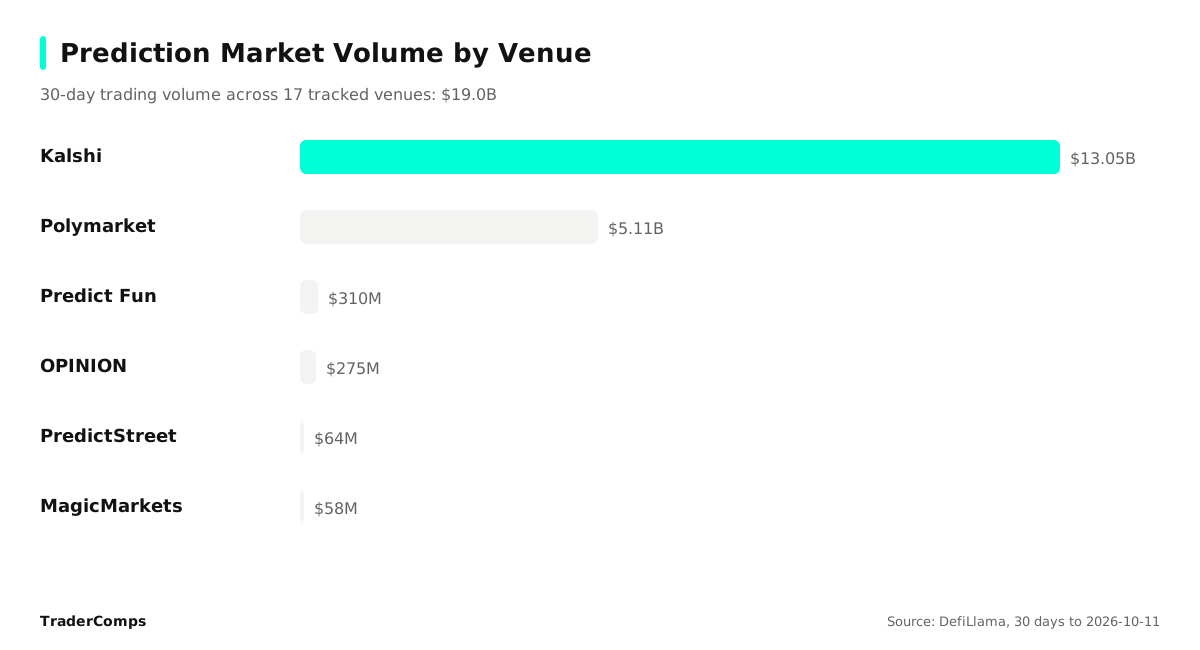
Two venues hold most of the activity. Across the 17 prediction markets DefiLlama tracks, 30-day volume to 11 October 2026 came to $19.0 billion, and Kalshi and Polymarket accounted for 95% of it. The venues we list, ordered by 30-day volume:
| Venue | 30-day volume (to 11 Oct 2026) | Open interest |
|---|---|---|
| Kalshi | $13.0 billion | $1.82 billion |
| Polymarket | $5.11 billion | $647 million |
| ADI PredictStreet | $63.8 million | Not tracked |
| Limitless | $6.0 million | Not tracked |
Figures are from DefiLlama via our prediction market rankings, refreshed daily. Open interest is the value of contracts still open; our guide to reading volume and open interest explains why the two differ.
Settlement and Resolution Risk
The result is only as good as the rule that decides it, and this is where prediction markets differ most from other trading.
On regulated exchanges, the exchange settles each market from the source named in its rules. Robinhood says the exchange's determination is final and it cannot override it, even if sports apps or news sites show a different result. If an event is cancelled, the exchange decides: a full refund, a $0 settlement or a non-standard payout (Robinhood).
Polymarket resolves through the UMA optimistic oracle. Anyone can propose an outcome by posting a $750 bond, and there is a two-hour window to dispute it before the market resolves, with disputes passing to UMA's own process (Polymarket). Limitless names an oracle source for each market when it is created, and its terms say an outcome based on that source is final and binding (Limitless).
The practical risks: a question worded loosely enough to be argued both ways, a delayed or disputed result that locks your money, and a cancelled event settled on terms you did not expect. And every position can go to zero.
Prediction Market Campaigns on TraderComps Now
These are the live campaigns on event contracts, ordered by end date. Each listing links to the venue's own terms.
- MEXC Prediction Markets Lucky Claw, ends 15 October. Trading 2,000 USDT of prediction markets in a day earns a draw for bonuses of up to 1,000 USDT; excludes the US, UK and Canada (MEXC).
- Limitless Points Season 4, ends 26 October. $200 of trading volume qualifies you for points, which Limitless says set your share of a future token airdrop (Limitless). Points have no stated cash value; see how points programs work.
- Bybit ByPick Season 1, ends 31 October. Free picks on crypto, sport and finance events earn points toward a 100,000 USDT pool; ranking needs 20 check-in days, 10 picks and verified identity (Bybit).
- Plus500 US $20 prediction markets bonus, ends 31 October. US first-time depositors who trade $10 of event contracts with code PLUSPM20 get $20, limited to the first 5,000 customers (Plus500 US).
- Gate WCTC S9, ends 25 November. Includes a 400,000 USDT event-contracts contest; registration runs 9 to 26 October, and the US and UK are excluded (Gate).
- OKX Event Contract Liquidity Rewards, no end date. For market makers who apply through OKX, not for most traders.
New listings appear on the prediction markets page, with related points programs and trading competitions. If you chase a volume target, read how trading competitions work first: fees on the volume can exceed the reward.
Before You Start
- Confirm prediction markets are legal where you live and that the venue accepts your country and state.
- Read the market's resolution rules: the source, the deadline and what happens if the event is cancelled.
- Work out the fee at your price and size, and check the spread before placing an order.
- Only stake what you can lose in full, since a losing contract pays nothing.
- For any reward, read the venue's own terms for minimums, regions and payout dates.
- Run the full check in how to check a trading campaign before you join.
This guide is information, not financial advice. Event contracts carry risk, rules differ by country, and campaign terms are set by each venue.
Questions and answers
What are prediction markets?
Prediction markets are exchanges where people buy and sell contracts on whether an event will happen, such as an interest rate decision, an election or a match result. Each contract pays $1 if the event happens and nothing if it does not, so its price, between 1 and 99 cents, shows what traders together expect. Some run as regulated exchanges, such as Kalshi in the US, and others run on a blockchain.
How do prediction market prices work?
A prediction market price is read as a rough probability. A yes contract at 70 cents means traders put the chance of the event at about 70%, and the matching no contract trades near 30 cents. If you buy at 70 cents and the event happens, you receive $1, so you make 30 cents before fees. If it does not happen, you lose the 70 cents you paid.
Are prediction markets legal?
Prediction markets are legal in some places and not in others. In the US, Kalshi, Polymarket US and Crypto.com's derivatives arm are exchanges designated by the CFTC, though some states contest their sports contracts. Great Britain's Gambling Commission treats prediction markets as gambling that needs its licence, and Australia's ACMA has asked internet providers to block Polymarket. Check the rules for your own country first.
How do prediction markets make money?
Prediction markets mostly make money from trading fees. Kalshi and Crypto.com publish a taker fee of 0.07 times the contracts, the price and one minus the price, which peaks at 1.75 cents a contract at 50 cents. Polymarket charges takers only and pays part of its fees back to makers. Brokers such as Robinhood add their own commission, and the spread between bid and ask is a further cost to traders.
Who decides the outcome of a prediction market?
Each prediction market names in its rules how the outcome will be decided. On regulated exchanges the exchange settles the market, and Robinhood says the exchange's decision is final even if other sources disagree. Polymarket uses the UMA optimistic oracle, where anyone can propose an outcome with a $750 bond and others can dispute it within two hours. Read the resolution rules before you trade, because they decide who gets paid.
Live Campaigns Related to This
Bitget
Crypto exchanges
Bitget CFD Championship (Phase 16)
75,000 USDT
Time left
Ends today
Score
4/5
To join
Medium
Trading competition · Stocks, Forex +2 · Excludes US, CA, DE, FR + more
MEXC
Crypto exchanges
BTC Carnival
$500,000 in rewards
Time left
1 day
Score
4/5
To join
No minimum
Prize pool · Crypto · Excludes US, UK, CA + more
BTCC
Crypto exchanges
TOKEN2049 Trade to Win
$1,000,000 prize pool incl. Tesla Cybertruck
Time left
1 day
Score
2.5/5
To join
See rules
Trading competition · Crypto · Excludes US, Ontario, Quebec