
Guide
How Points Programs and Airdrops Work
How points seasons are earned and scored, why points rarely have a set token value, and what to check before farming an airdrop.
 By Julian Stafford, Co-Founder, Surgence Labs · 11 Oct 2026 · 6 min read
A points program rewards activity on a venue with points that have no stated cash value, usually on the understanding that they may count toward a future token airdrop. The airdrop is the payout itself: tokens sent to, or claimable by, eligible wallets and accounts. Points are a possibility, not a promise of payment, so treat them as a bonus on trading you would do anyway.
What a Points Season Is
Most points programs run in seasons. Each week, the venue releases a fixed number of points and splits them among users according to their activity that week.
- Arcus Points Season 1 pays a fixed 250,000 points every Wednesday.
- Pacifica shares 10,000,000 points a week.
- Nado Season 2 scales its weekly pool between 300,000 and 950,000 points with protocol volume.
- Extended distributes no more than 600,000 points a week.
Because the pool is fixed, your share depends on everyone else. If twice as many people trade next week, the same activity earns you fewer points.
Seasons end, though not always on a known date. Limitless Points Season 4 runs 25 May to 26 October 2026, while Arcus says its season ends no later than H1 2027 and RISEx no later than Q2 2027. Formats also change mid-stream: after its regular season ended on 30 April 2026, Hibachi moved to a Playoffs phase with new weekly multipliers.
Centralised exchanges use points differently. HTX's Futures Points Contest and Bybit's ByPick Season 1 turn points into stated prizes such as gold, tokens, trial bonuses or USDT. Those are closer to a trading competition than to a pre-token airdrop.
How Points Are Earned
Each venue sets its own formula, but the inputs come from a short list.
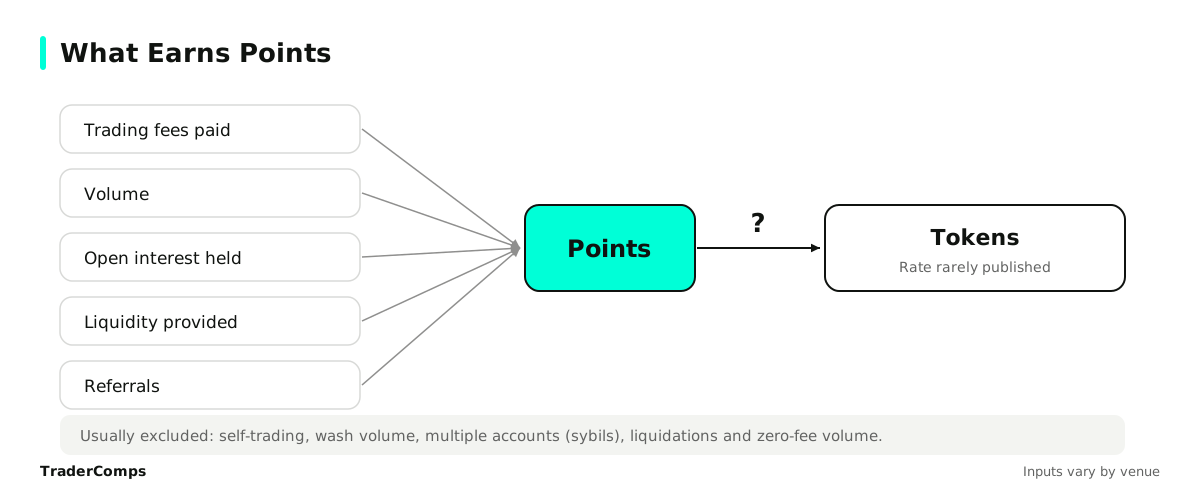
- Fees and volume. The base of most programs. RISEx scores fees paid and maker and taker volume.
- Open interest and hold time. RISEx also scores open interest and how long positions are held, which rewards real positions over quick churn.
- Liquidity. Limitless rewards liquidity providers in thin markets, and Arcus rewards market making.
- Deposits. Arcus counts retained deposits, so money that stays on the venue earns points.
- Referrals. RISEx gives referrers an extra 10% of their referees' points, and Arcus includes referrals in its scoring.
- Multipliers. Hibachi offers up to 1.5x for hitting weekly volume thresholds on featured markets, Limitless tiers add up to 20%, and Lighter pays double points for trades routed through Robinhood Wallet.
- Quality adjustments. Nado adjusts each trader's share for fee tier and toxicity, and RISEx scores trading quality.
Why There Is Usually No Conversion Rate
Very few programs say what a point is worth. Extended's docs say points may be considered in a future token distribution under separate terms. Pacifica's formula is undisclosed and changes each week. RISEx does not publish its scoring model. Nado says Season 2 points convert to INK at the token generation event, but a named token is not a price.
Keeping the conversion open lets a team adjust for farming and decide the final allocation once it knows how much activity it bought. For you, it means every point is an unpriced claim on an unknown slice of a token that may not exist yet.
Variational is a useful counter-example. It has said it will airdrop 32% of VAR supply to Omni points holders, and that any wallet with at least one point qualifies. Even then, the value per point depends on the total points issued and on the token's price after launch.
Snapshots, Token Launches, Vesting and Claims
Four terms come up in every airdrop.
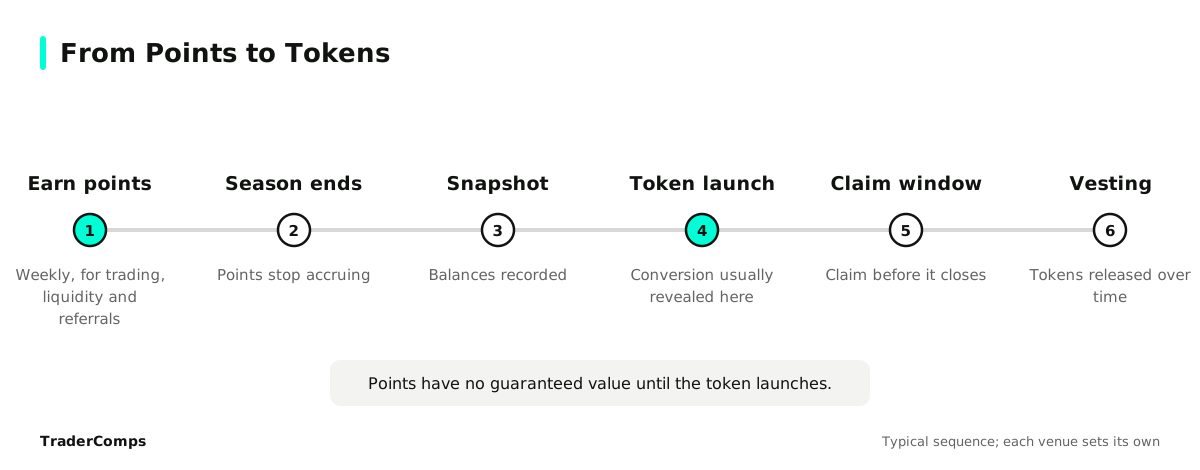
- Snapshot. The moment the venue records balances. Activity after the snapshot does not count for that distribution.
- Token generation event (TGE). When the token is created and can start trading. Dates can stay vague for a long time: Variational plans VAR for Q4 2026 but has not set an exact date.
- Vesting. Some airdrops release tokens in stages over months. Others release everything at once; Variational says its airdrop has no vesting.
- Claim window. You may have to claim within a set period. Unclaimed tokens can be lost: Variational says unclaimed VAR will be burned.
Exchange airdrops work differently. Gate's CandyDrop, Bitget's CandyBomb and Binance's Hold RLUSD campaign all pay a known asset from a fixed pool during a set window. The question there is your share, not what the token will be worth.
Tax applies too, and rules differ by country. In the UK, HMRC says an airdrop received in return for doing something can be taxed as income, and selling an airdropped token may give rise to Capital Gains Tax (HMRC).
Sybil and Self-Trading Rules
A sybil is one person posing as many users, usually through many wallets, to claim a bigger share. Venues filter for it and write it out of the rules.
- Lighter excludes wash trading, sybil accounts and automated farming.
- Pacifica says self-trading and sybil activity earn nothing, and points cannot be bought.
- Nado adjusts each trader's share for toxicity as well as fee tier.
Trading against yourself to build volume pays fees for nothing and puts the whole allocation at risk.
The Risks
- No guaranteed value. Points can end up worth little, or nothing if a token never launches.
- Cost of farming. You pay real fees and funding now for an uncertain reward later. A fixed weekly pool spread across more users dilutes everyone.
- Smart contract risk. Decentralised venues run on code. Deployed contract code usually cannot be patched, and stolen assets are mostly unrecoverable (ethereum.org).
- Venue risk. A venue can change rules mid-season, pause, or close. Funds held there are exposed to whatever happens to it.
- Regional bans. Lighter's program excludes the US, UK, Canada, China, Russia, Singapore, the UAE, Switzerland, Ukraine and other listed countries. Arcus excludes the US, Canada and the UK. The UK also bans incentives to invest in cryptoasset promotions (FCA). If your country is excluded, assume your activity will not count.
- Token price. A new token can fall sharply after launch, and vesting can stop you selling.
Checklist Before You Farm Points
- Read the venue's own points docs and note the season dates.
- Confirm your country is eligible for both the program and the eventual claim.
- Find out what earns points: volume, fees, open interest, liquidity, deposits or referrals.
- Check whether the weekly pool is fixed, and how many users share it.
- Look for any stated token, allocation, vesting or claim window, and assume none if it is not written down.
- Add up the fees and funding you would pay at the size you plan to trade.
- Use one wallet or account and never trade against yourself.
- Only deposit what you could afford to lose if the venue or its contracts fail.
See every live points season on TraderComps, and token distributions on Airdrops.
This guide is information, not financial advice. Trading carries risk, and campaign terms are set by each venue.
Live Campaigns Related to This
Upbit
Crypto exchanges
KAIA/KRW Zero Trading Fee Event
0% trading fee on KAIA/KRW (from 0.05%)
9 Oct to 11 Oct
Ends today
Bitget
Crypto exchanges
Bitget CFD Championship (Phase 16)
75,000 USDT
5 Oct to 12 Oct
Ends tomorrow
MEXC
Crypto exchanges
BTC Carnival
$500,000 in rewards
22 Sep to 13 Oct
2 days left