
Guide
How Trading Competitions Work
How trading competitions rank traders, who can enter, how prizes are paid, and what the trading really costs before you join one.
 By Julian Stafford, Co-Founder, Surgence Labs · 11 Oct 2026 · 5 min read
A trading competition is a time-limited contest where a venue ranks traders on a set measure, usually trading volume or profit, and pays a prize pool to the people at the head of the leaderboard. The venue runs it to bring in volume and new users. You still pay your own fees and carry your own risk, so a prize is only worth chasing if the trading makes sense without it.
The Main Formats
Most competitions are one of five shapes, and many mix two or three.
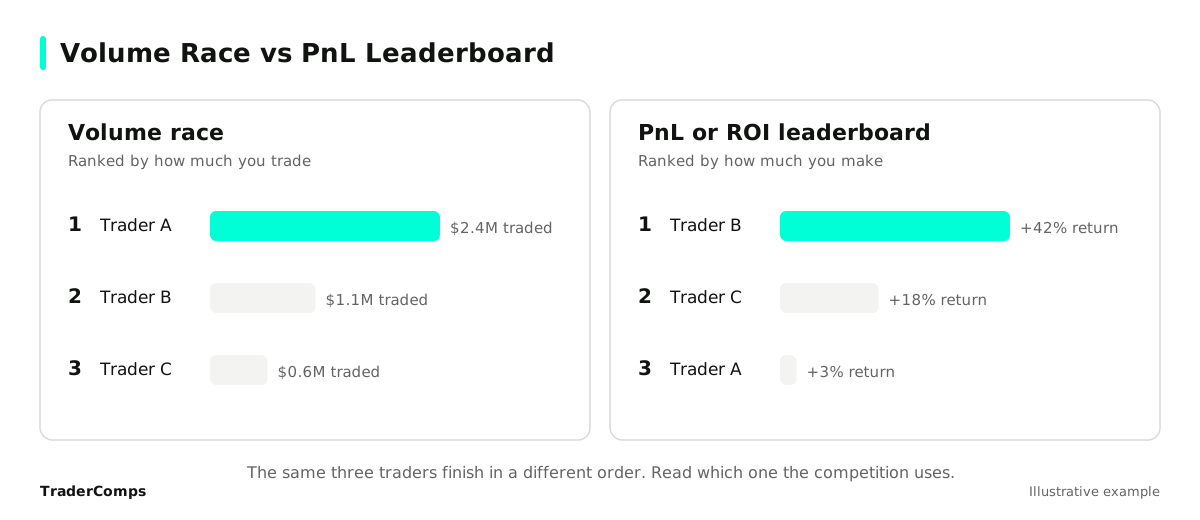
- Volume races. The more you trade, the higher you rank. Binance's Spot Trading Tournament Season 4 runs for one week on two spot pairs: the leading 1,000 traders share fixed BNB voucher allocations, and everyone else above a $500 minimum gets a capped proportional share.
- PnL and ROI leaderboards. You rank on profit, either in dollars or as a percentage of your account. HFM's Traders Awards pays $1,000 cash each month to the live account with the biggest percentage gain. The Blackboard x Aster competition runs a volume board and a PnL board side by side.
- Blended scores. Some venues combine measures. Extended's Final Arc ranks on PnL multiplied by weighted volume and time-weighted open interest, and counts maker fills at only 10%.
- Team competitions. You join or form a team and the team ranks together. Gate's WCTC S9 needs at least five members per team and sends most of its pool to teams, with separate pools for individuals and for event contracts.
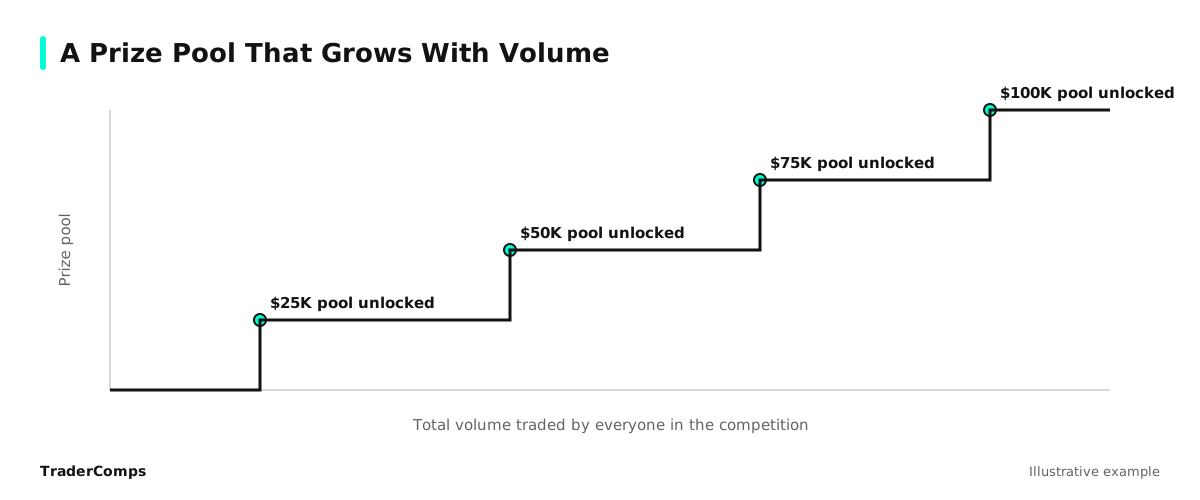
- Pools that scale with volume. The prize grows as everyone trades more. Bybit's Stock Buzz: Trade Micron pool scales with total community volume up to 100,000 USDT, and the Aster pool starts at $17,000 and steps up across seven levels.
Then there are lucky draws and task rewards. MEXC's Prediction Markets Lucky Claw turns daily volume into claw machine plays, and Bitget's CFD Championship adds mystery boxes for daily volume tasks alongside a leaderboard. These reward taking part rather than winning.
How Rankings and Eligibility Work
The headline prize matters less than the rules underneath it. Read these first.
- Registration. Many contests only count volume after you press a join button. Gate's WCTC has a separate registration window before the competition itself starts.
- Identity checks. Centralised exchanges usually require a verified account to receive a prize. Binance's tournament terms say only verified users who meet the criteria by the end of the period can receive rewards (Binance).
- Minimum volume. You often need a floor of volume before you rank at all: $10,000 on Kraken's Pre-IPO Challenge, $20,000 on the Bybit Micron race, $50,000 of qualified volume on the Aster contest.
- Regions. Each contest lists who can join. The Kraken challenge excludes the UK, EEA, US, Canada, Australia and New Zealand. Part of the reason is local law: the UK bans incentives to invest in cryptoasset promotions (FCA), and EU regulators restricted the incentives offered to trade CFDs (ESMA).
- Weighting. Not all volume counts the same. Extended counts crypto taker fills fully, RWA taker fills at 50% and maker fills at 10%. Gate weights volume across spot, futures, stocks, options, event contracts and CFDs.
- Sub-accounts. Rules vary. Binance's tournament counts master and sub-account volume together. Other venues exclude sub-accounts or treat them as separate entrants.
- Wash trading and self-trading. Trading with yourself, or between accounts you control, to inflate volume is against the rules. Binance reserves the right to disqualify accounts for wash trading, bulk account registration, self dealing or market manipulation, and says disqualified rewards are not returned to the pool.
How Prizes Are Paid
"Prize pool" covers many different things, and they are not all cash.
- Stablecoins. Bybit pays in USDT, Kraken in USDG, and Extended's Final Arc pays $250,000 in cash across 500 winners.
- Tokens and token vouchers. Binance pays its tournament in BNB vouchers, HTX's futures contest in HTX tokens, and Gate's BTC vs ETH Showdown in tokenised Intel stock. A token prize moves with the market between the day you win and the day you sell. Vouchers can also expire: Binance's terms say its tournament vouchers expire 21 days after distribution.
- Bonuses and position credits. Some prizes are trading credit, not money. Bybit's help centre says bonuses cannot be withdrawn under any circumstances, though they can cover margin, fees and funding, and profits made with them can be withdrawn (Bybit). edgeX's Arc Genesis campaign hands out random position airdrops to registrants.
- Physical prizes. BTCC's TOKEN2049 Trade to Win offers a Tesla Cybertruck for first place, with Apple devices and vouchers further down.
Payment comes after the contest ends, not as you trade. Binance's terms, for example, set distribution for up to two weeks after its tournament closes.
The Real Costs
The prize is visible. The cost of competing for it is not, and it can be larger.
- Trading fees. Every fill pays a fee. At a 0.05% taker fee, $1 million of volume costs $500, and ranking on a busy volume board can take many times the minimum.
- Funding. Perpetual futures charge funding between longs and shorts, by default every 8 hours on Binance (Binance). Holding positions to build volume or open interest adds up.
- Spread and slippage. Some contests run on newly listed or thin markets, where every round trip loses a little to the spread.
- Leverage risk. High leverage builds volume fast and liquidates accounts fast. When ESMA reviewed CFD trading, it found 74% to 89% of retail accounts typically lose money (ESMA).
Put together, chasing a leaderboard can cost more than the prize. Pools are split many ways, rivals can always trade more than you, and your fees are paid whether you place or not. The sound approach is to join contests on markets you already trade, at the size you already trade, and treat any prize as a rebate.
Checklist Before You Join
- Read the official terms on the venue's own site, not a summary.
- Check the start, end and any registration window, and whether you must opt in.
- Confirm your country is eligible and that your account is verified.
- Note the ranking measure, the weights and the minimum volume.
- Find out what the prize is paid in, when, and whether it expires or can be withdrawn.
- Estimate your fees and funding at the volume you would realistically need.
- Set a loss limit for the contest that has nothing to do with the leaderboard.
- Trade from one account and never trade against yourself.
See every live trading competition on TraderComps, or browse them by date on the calendar.
This guide is information, not financial advice. Trading carries risk, and campaign terms are set by each venue.
Live Campaigns Related to This
Upbit
Crypto exchanges
KAIA/KRW Zero Trading Fee Event
0% trading fee on KAIA/KRW (from 0.05%)
9 Oct to 11 Oct
Ends today
Bitget
Crypto exchanges
Bitget CFD Championship (Phase 16)
75,000 USDT
5 Oct to 12 Oct
Ends tomorrow
MEXC
Crypto exchanges
BTC Carnival
$500,000 in rewards
22 Sep to 13 Oct
2 days left