
Guide
How to Read Trading Volume and Open Interest
What trading volume and open interest measure, why their ratio matters, where the numbers come from and how to use them to pick a venue.
 By Julian Stafford, Co-Founder, Surgence Labs · 11 Oct 2026 · 6 min read
Trading volume tells you how much changed hands over a period. Open interest tells you how much is still at stake in derivatives that have not been closed. Read together, they show whether a venue's activity looks like real positioning or like turnover generated to earn rewards.
What Trading Volume Measures
Volume is the total value of trades executed in a period. On TraderComps it is shown in US dollars. Every trade counts, whether it opens a position or closes one.
- Spot volume is buying and selling the asset itself. You pay in full and you own what you bought.
- Derivatives volume is trading contracts that track a price: futures, options and perpetual futures (perps, which have no expiry date). Positions are opened on margin, so a trader can turn over many times their deposit.
That margin effect is why derivatives numbers dwarf spot on most large exchanges. At the time of writing (11 October 2026), CoinGecko showed about $20.5 billion of 24-hour derivatives volume on Binance against about $5.0 billion of spot.
24-Hour and 30-Day Volume
A 24-hour figure is a snapshot. One liquidation cascade, one big listing or the last day of a competition can double it. A 30-day figure smooths those spikes out and shows the habit rather than the moment.
At the time of writing (11 October 2026), DefiLlama showed Uniswap at about $1.1 billion over 24 hours and $82.8 billion over 30 days, and Kalshi at about $459 million and $13.0 billion. Compare like with like: 24 hours against 24 hours, 30 days against 30 days. That is why our decentralised exchange rankings sort spot venues by 30-day volume, and our prediction market table does the same.
What Open Interest Measures
Open interest is the value of derivatives positions that are still open. CME Group's introduction to futures puts the difference simply: volume counts every contract traded, while open interest counts the contracts that remain open. It rises when new positions open and falls when they close.
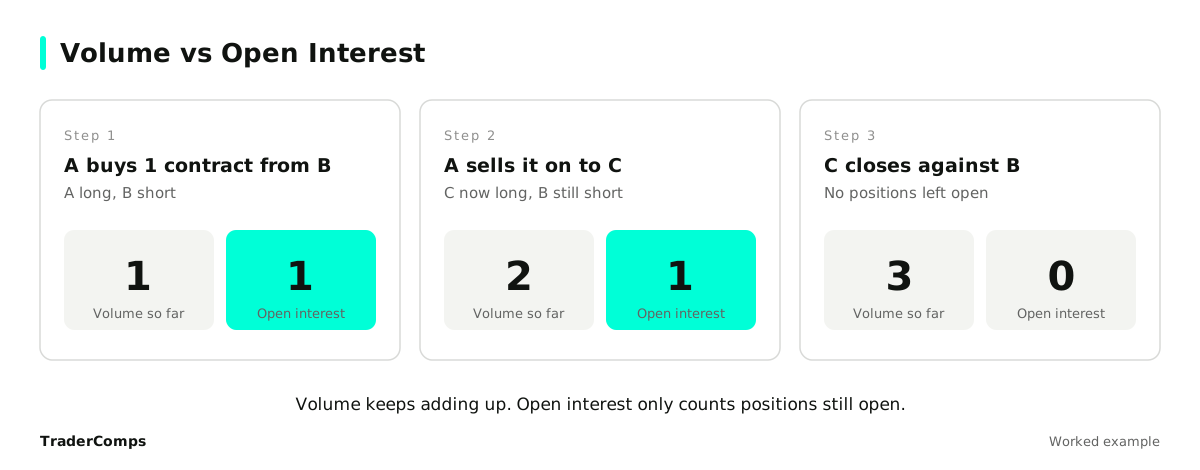
That makes open interest harder to fake. A trader who opens and closes a position in the same minute adds volume twice and leaves open interest unchanged. Open interest needs capital left at risk.
Spot markets have no open interest. On prediction markets it is the value of contracts still outstanding before their markets settle. At the time of writing (11 October 2026), DefiLlama showed about $7.9 billion of open interest on Hyperliquid and about $1.8 billion on Kalshi.
Why the Volume-to-Open-Interest Ratio Matters
Divide 24-hour volume by open interest and you get a turnover ratio. A ratio of 1x means the venue traded the value of its whole open book once in a day.
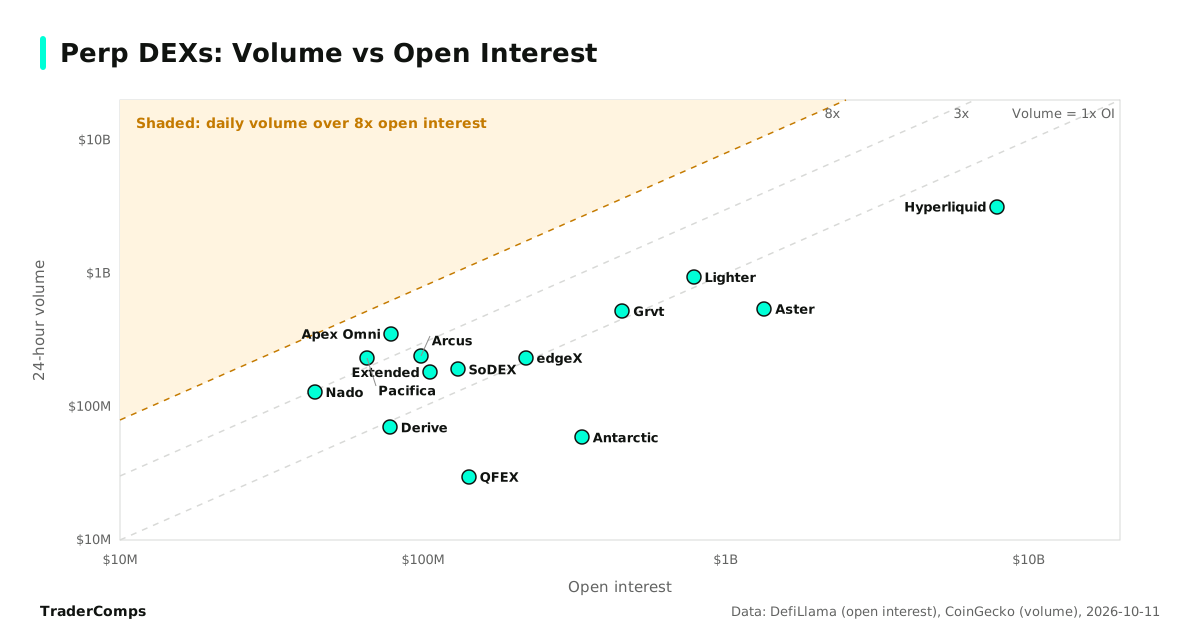
At the time of writing (11 October 2026), Hyperliquid was at about 0.4x, Lighter at about 1.2x and Binance's derivatives market at about 0.6x. Day trading and market making are normal, so healthy ratios vary from venue to venue and from day to day.
A very high ratio means a lot of trading and very little held. That is what you would expect when traders are paid per dollar traded, or when the same money trades against itself. A study of 29 exchanges, published in Management Science, estimated that wash trading averaged over 70% of reported volume on the unregulated exchanges in its sample.
Our rankings shade any ratio above 8x in amber. Treat it as a prompt to look closer, not a verdict. A new venue with little open interest can show a high ratio for ordinary reasons, and a market-wide sell-off lifts volume everywhere.
How Incentives and Points Programs Inflate Volume
Most points programs and trading competitions reward volume. Hibachi's Points Playoffs give multipliers of up to 1.5x to traders who hit weekly volume thresholds on featured markets. Binance's Spot Trading Tournament Season 4 ranks traders by volume on two pairs, with a $500 minimum.
When the reward for each dollar traded is worth more than the fee, trading back and forth pays. Volume goes up and open interest does not move. Venues know this. Pacifica's points program says self-trading and sybil activity earn nothing, and Lighter's points rules exclude wash trading, sybil accounts and automated farming. Rules like these are good practice. They also tell you the behaviour exists.
So when a venue is running a large points season, read part of its volume as paid for. Open interest and fees are better guides to how much activity would stay if the rewards stopped.
Where the Numbers Come From
On-chain venues: DefiLlama. DefiLlama builds its volume, fee and open interest figures from open-source adapters, most of them maintained by the protocols' communities in the public dimension-adapters repository. Its documentation asks adapters to prefer on-chain event logs and contract calls, and to watch for wash trading on low-fee chains.
Not every venue in an on-chain table settles everything on-chain. DefiLlama tags some as "Off Chain". At the time of writing (11 October 2026), that tag applied to Aster and Kalshi in our data, so their figures come from the venue's own reporting.
Centralised exchanges: CoinGecko. CoinGecko's methodology says derivatives exchanges are ranked on open interest and volume "as reported". Those numbers come from the exchange's own API. CoinGecko quotes them in bitcoin and we convert them to dollars at the bitcoin price when we refresh.
Self-reported and on-chain data are different kinds of evidence. On-chain trades can be checked by anyone, but the chain does not tell you who sits on both sides, so wash trades still show up as volume. Self-reported figures rest on trusting the exchange. Neither proves real demand on its own. For on-chain perps we take open interest from DefiLlama and 24-hour volume from CoinGecko where it lists the venue. The full method is on our methodology page.
Trust Scores
CoinGecko gives spot exchanges a trust score from 1 to 10. Its methodology bases the score on liquidity, regulation, cybersecurity, past incidents and proof of reserves. Its May 2026 update replaced web traffic with direct volume and order book depth, added a regulation score and grades exchanges against their peers. CoinGecko does not publish a trust score for derivatives exchanges.
Our crypto exchange rankings order spot exchanges by trust score first, then volume. Our beta venue score uses the trust score, or the volume-to-open-interest ratio for on-chain venues, as its activity quality part, worth 15 of 100 points.
How to Use These Numbers When Choosing Where to Trade
Start with open interest for derivatives. It tells you how much capital is committed and gives a rough feel for whether a venue can absorb your size without heavy slippage. Then read volume against it.
Use 30-day volume to judge the venue and 24-hour volume to judge the day. Check whether the figure is on-chain or reported. Then look at what the venue is paying for. A venue page on TraderComps lists its live campaigns, so you can see whether a jump in volume lines up with a new competition or points season.
None of these numbers says a venue is safe. Custody, regulation and whether you are allowed to use it from your country are separate questions.
A Quick Checklist
- Is open interest large enough for the size you trade?
- Is the volume-to-open-interest ratio flagged amber?
- Are you comparing 24 hours with 24 hours and 30 days with 30 days?
- Is the figure on-chain or reported by the exchange?
- What points program or competition is running on the venue right now?
- What is the trust score, and what do fees say about activity without rewards?
Every figure in this guide is live on the rankings, and the campaigns that might be driving it are on the calendar.
This guide is information, not financial advice. Trading carries risk, and campaign terms are set by each venue.
Live Campaigns Related to This
Upbit
Crypto exchanges
KAIA/KRW Zero Trading Fee Event
0% trading fee on KAIA/KRW (from 0.05%)
9 Oct to 11 Oct
Ends today
Bitget
Crypto exchanges
Bitget CFD Championship (Phase 16)
75,000 USDT
5 Oct to 12 Oct
Ends tomorrow
MEXC
Crypto exchanges
BTC Carnival
$500,000 in rewards
22 Sep to 13 Oct
2 days left