
Guide
How Polymarket Works: Shares, Prices, Fees and Resolution
How does Polymarket work? Shares that pay $1, prices as odds, the order book, fees by category, the UMA oracle, Polymarket US and whether it is legit.
 By Julian Stafford, Co-Founder, Surgence Labs · 13 Oct 2026 · 9 min read
Polymarket works as an exchange for event shares: you buy a "Yes" or "No" share on whether something will happen, at a price between 1 and 99 cents, and each share on the right side pays $1 when the market resolves. So how does Polymarket work from sign-up to payout? There are two products, the international site on the Polygon blockchain and Polymarket US, an exchange regulated by the CFTC, and this guide covers funding, prices, the order book, fees, how results are decided and whether Polymarket is legit, as at 13 October 2026. New to the idea? Start with what prediction markets are.
Two Products Under One Name
Polymarket describes its international product as crypto-based and running on a blockchain, and Polymarket US as a separate platform in US dollars that operates as a designated contract market and derivatives clearing organisation under CFTC oversight (Polymarket US). The US exchange is QCX LLC, trading as Polymarket US, and its clearing house is QC Clearing LLC, trading as Polymarket Clearing (Polymarket US Rulebook). The international site is not open to US traders. Whether Americans can use either one is a question of its own, covered in is Polymarket legal in the US.
Step 1: Open an Account and Fund It
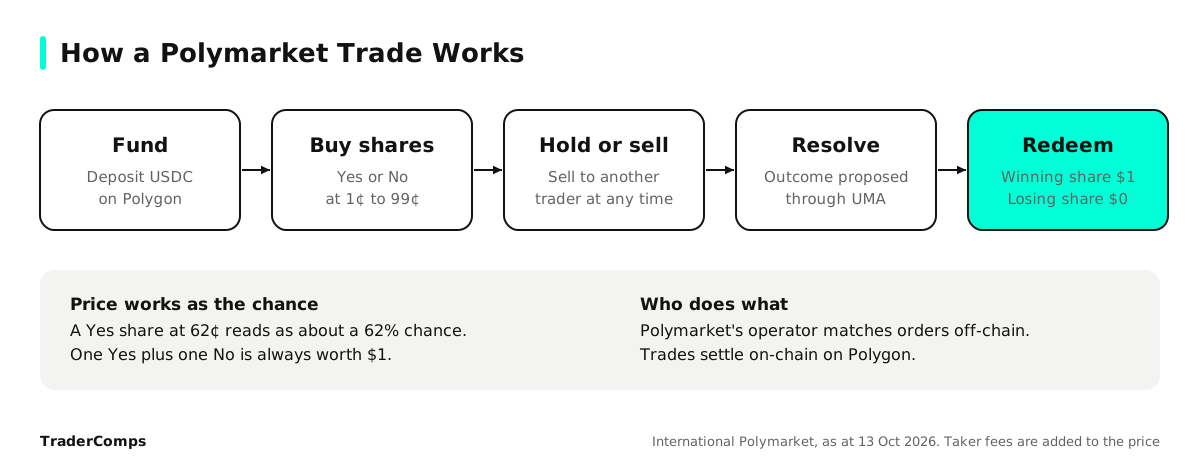
On the international site your money sits in a crypto wallet on Polygon. Since an exchange upgrade in 2026, the exchange trades in its own collateral token: USDC you deposit is wrapped into it through an on-chain onramp and can be unwrapped back the same way (Polymarket on GitHub). Polymarket calls this token pUSD and says it is backed one to one by USDC (Polymarket).
Polymarket US works like a brokerage app. You sign up with Google or Apple, then give your legal name, date of birth, address, phone number and Social Security number; some users are also asked for a government ID and a selfie, and you must pass these checks before you can deposit or trade (Polymarket US). You must be at least 18 and of age of majority where you live (Polymarket US Rulebook). You can fund it by debit card, bank transfer, Apple Pay, PayPal, Venmo, USDC where available, or wire. Card and bank deposits take 3 to 4 business days to clear before you can withdraw them, and withdrawals go back to the method you paid in with (Polymarket US).
Step 2: Shares That Pay $1, and Prices as Probabilities
Every market asks a yes or no question. Each share settles at $1 if the event happens and $0 if it does not, and you can trade until the outcome is known (Polymarket US). Yes and No always add up to $1: if Yes trades at 60 cents, No is 40 cents (Polymarket US).
That is why the price reads as a probability. A Yes share at 62 cents means traders, taken together, put the chance at about 62%. Buy at 62 cents and you make 38 cents a share if you are right, before fees, and lose the 62 cents if you are wrong. Our event contracts page lists the markets of this kind we track.
Step 3: The Order Book
Prices are set by traders on an order book, not by Polymarket. A limit order rests on the book at your price until someone takes it or you cancel it; a market order fills at once against the orders already on the book, and you pay the spread (Polymarket US). You can sell before the result is known at whatever another trader will pay.
On the international site, Polymarket runs a hybrid model: an operator it controls matches orders off-chain, and the matched trades settle on-chain, without Polymarket holding the funds (Polymarket on GitHub). That makes trading fast, but it means the company runs the matching.
Step 4: Fees by Category
Both products use the same shape of taker fee: a rate times the number of shares times the price times one minus the price. It is largest at 50 cents and shrinks towards 1 and 99 cents. On the international site the rate depends on the market's category, and makers, whose resting orders are filled, pay nothing (Polymarket). On Polymarket US the taker rate is 0.0695 on almost every market and 0.10 on table tennis (Polymarket US).
| Product and category | Taker rate | Taker fee on 100 shares at 50 cents |
|---|---|---|
| International: crypto | 0.07 | $1.75 |
| International: sports, economics, culture, weather, other | 0.05 | $1.25 |
| International: finance, politics, tech, mentions | 0.04 | $1.00 |
| International: geopolitics and world events | 0 | $0.00 |
| Polymarket US: standard | 0.0695 | $1.74 |
| Polymarket US: table tennis | 0.10 | $2.50 |
Polymarket US is changing its rebates on 19 October 2026. Until then makers earn a flat rebate, $0.31 on 100 contracts at 50 cents. From 1pm Eastern on 19 October, maker and taker rebates depend on the previous month's volume, starting at $10 million of maker volume or $250,000 of taker volume; below those levels there is no rebate. Taker fees are unchanged (Polymarket US). Kalshi vs Polymarket sets these fees beside Kalshi's.
Step 5: How Markets Resolve
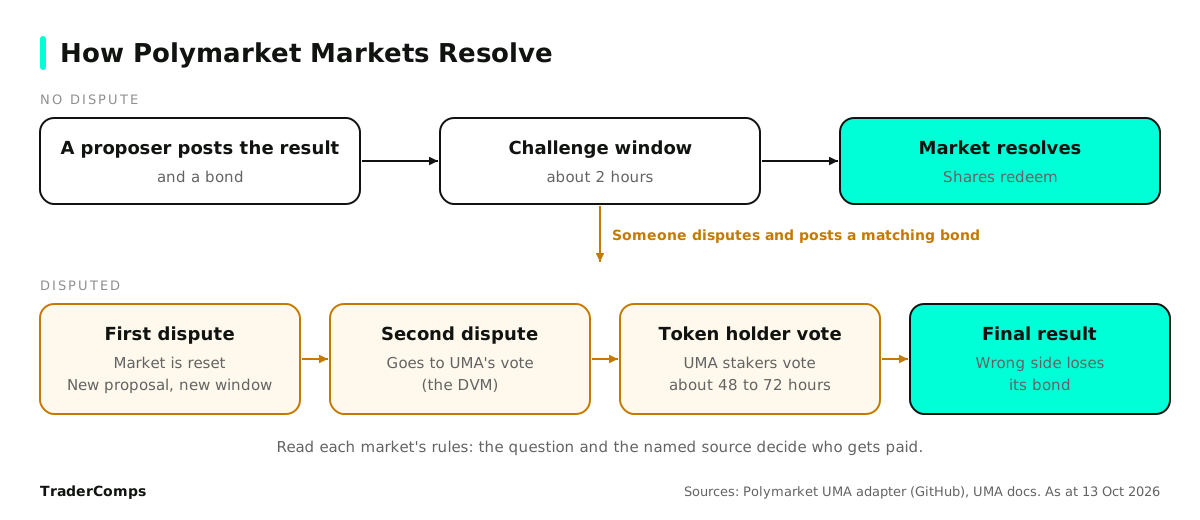
On the international site, results come from UMA's optimistic oracle. Polymarket's adapter contract sends each market's question to the oracle. A proposer answers it, and if nobody disputes within the liveness period, currently about two hours, the market resolves (Polymarket on GitHub).
Disputes cost money. The proposer posts a bond, and a disputer must post one too; each bond is returned to whoever turns out to be right, and a correct disputer receives part of the proposer's forfeited bond (UMA). Polymarket says the proposer's bond is typically $750 (Polymarket). The first dispute on a market resets it with a new request, so a careless dispute does not hold it up. A second dispute sends the question to UMA's Data Verification Mechanism, a vote of UMA stakers, which returns a result after 48 to 72 hours (Polymarket on GitHub; UMA).
The vote is where the risk sits. In March 2025 a market of about $7 million on a Ukraine minerals deal resolved Yes before any deal was signed, after users alleged a large UMA holder swung the vote; Polymarket declined refunds and said it was working with UMA to stop a repeat (The Block).
This is changing. Polymarket's rebuilt contracts, Protocol V2, resolve through an oracle aggregator with modules for UMA, Chainlink and others (Polymarket on GitHub). The Block reported that Polymarket began trial markets on V2 in October 2026 and set 2 November 2026 as a tentative date to move all new markets to it (The Block).
Polymarket US works differently. The exchange decides each result from the sources named in the market's rules, such as a government body, a league or a named news outlet, and its resolutions are final under its rulebook (Polymarket US). For sports, a winner market with no draw option settles each side at 50 cents if the game ends tied (Polymarket US).
Is Polymarket Legit?
Polymarket is a real, long-running exchange, and it has a record worth reading in full before you deposit.
In its favour. The CFTC's 2022 order records that Polymarket had been operating since about June 2020 (CFTC). Its exchange contracts were audited by ChainSecurity (GitHub) and its UMA adapter by OpenZeppelin (GitHub), and the V2 exchange by Quantstamp and Cantina in March 2026 (GitHub). The Block reported six audits of Protocol V2 and a bug bounty of up to $5 million (The Block). On Polymarket US, customer funds are held in a dedicated customer account, separate from the company's operating funds (Polymarket US).
Against it. In January 2022 the CFTC fined Polymarket $1.4 million for offering event-based binary options without registering, and ordered it to wind down the non-compliant markets (CFTC). Security incidents have hit users even where the contracts held:
- December 2025: a small number of accounts were drained through a flaw at a third-party login provider, Polymarket said (The Block).
- May 2026: about $520,000 was taken after the key to an internal operations wallet was compromised; Polymarket said user funds were safe (CoinDesk).
- June 2026: malicious code injected through a third-party script on the website drained about $3 million from fewer than 15 wallets, by independent estimates; Polymarket pledged to reimburse them in full (BleepingComputer).
Regulators in several countries block the international site. Australia's ACMA asked internet providers to block it in August 2025 as an illegal online gambling service (ACMA). In the US, Polymarket US faces suits from states including Nevada and New York, set out in our legal guide.
Polymarket on TraderComps
Polymarket is second to Kalshi on 30-day volume among the prediction markets in our rankings. On 13 October 2026, DefiLlama's figures showed Polymarket at about $136 million of 24-hour volume, $5.16 billion over 30 days and $526 million of open interest, against $14.8 billion of 30-day volume for Kalshi. Our guide on how Kalshi works covers its rival.
Live listings linked to Polymarket, as at 13 October 2026:
- Polymarket Perps launch: perpetual futures added in September 2026, with up to 20x leverage on some markets and no launch reward announced.
- Funding Predicts' free $1,000 account: a simulated evaluation on live Polymarket prices from Funding Predicts, a prop firm.
Polymarket US gives new users a $25 trading credit after a first deposit of at least $10, and its Refer-A-Friend program gives $25 each to the referrer and the friend, up to 50 referrals. The credits can open positions and pay fees but cannot be withdrawn as cash (Polymarket US). The international site's referral program pays existing traders a share of fees, with no published bonus for the new user (Polymarket). More sign-up offers are on our bonuses page and the full Polymarket platform profile; the prediction markets page has every live campaign.
Before You Trade
- Check which product you can legally use where you live, and never use a VPN to get around a block.
- Work out the taker fee at the price you plan to pay; selling before the result is a second fee.
- Read each market's rules and named source, since they decide the result, not the headline.
- On the international site, know that a disputed market can take days to resolve.
- Treat bonus credit as trading credit, not cash.
- Only stake money you can afford to lose in full.
This guide is information, not financial or legal advice. Polymarket's fees, rules and availability change: check its own pages before you trade.
Questions and answers
How does Polymarket work?
Polymarket is an exchange where you buy Yes or No shares on the outcome of an event, priced between 1 and 99 cents. A winning share pays $1 when the market resolves and a losing one pays nothing, so the price reads as the market's estimate of the chance. You trade against other people on an order book, and Polymarket charges takers a fee that depends on the price and the market's category.
How does Polymarket decide the result of a market?
On the international site, results come through the UMA optimistic oracle. Someone proposes the outcome and posts a bond, and anyone can dispute it within a challenge window of about two hours. A first dispute resets the market; a second sends it to a vote of UMA token holders, which takes about 48 to 72 hours. Polymarket US settles markets itself from the sources named in each market's rules.
What is the difference between Polymarket and Polymarket US?
They are separate products. The international site runs on the Polygon blockchain, uses a crypto wallet and USDC-backed collateral, and is not open to US traders. Polymarket US is QCX LLC, an exchange designated by the CFTC, the US derivatives regulator. It trades in US dollars, checks every customer's identity, including a Social Security number, and requires users to be 18 or older.
Is Polymarket legit?
Polymarket is a real exchange that has run since 2020, with audited smart contracts and a US arm regulated by the CFTC since 2025. It has also paid a $1.4 million CFTC penalty in 2022, faced disputed resolutions, had account and website security incidents, and is blocked by regulators in several countries, including Australia. Weigh both sides, and only trade money you can afford to lose.
Does Polymarket have a sign-up bonus?
Polymarket US, the US app, gives new users a $25 trading credit after a first deposit of at least $10, and its Refer-A-Friend program gives $25 to both people. The credit can be used to trade and pay fees but cannot be withdrawn as cash. The international site publishes no sign-up bonus for new users, as at 13 October 2026.
Live Campaigns Related to This
IG
Brokers
SHARES1K bonus shares for new share dealing clients
Random allocation of shares worth £50 to £1,000
Time left
1 day
Score
Not rated
To join
Medium
Sign-up bonus · UK only
Coinstore
Crypto exchanges
MNR Invite & Plant: Share 1,000U Worth $MNR
666 MNR (stated as worth 1,000 USDT)
Time left
4 days
Score
Not rated
To join
Medium
Referral · Crypto
FTMO
Prop firms
FTMO Futures launch competition (partners)
Up to 10 FTMO Futures Pro 100K accounts for first place
Time left
5 days
Score
Not rated
To join
High
Referral · Futures · Global, FTMO partners only