
Guide
How Kalshi Works: Event Contracts, Fees and Who Can Trade
How does Kalshi work? Yes and no contracts that pay $1, the published fee formula, deposits, who can sign up and how markets settle.
 By Julian Stafford, Co-Founder, Surgence Labs · 11 Oct 2026 · 7 min read
Kalshi works as a US exchange for event contracts: you buy a "yes" or "no" contract on whether something will happen, at a price between 1 and 99 cents, and each contract on the right side pays $1 when the market settles. So how does Kalshi work in practice? It is regulated by the CFTC, earns money from a trading fee rather than from your losses, and matches you against other traders on an order book. This guide covers the contracts, the fee formula, deposits, who can sign up and how results are decided, as at 12 October 2026.
What an Event Contract Is
An event contract is a derivative whose value depends on the outcome of an event. The CFTC describes most of them as yes or no questions with a fixed payout, usually $1, and an expiry date (CFTC). Kalshi calls itself the first regulated exchange for trading on the outcome of events, with markets on politics, economics, culture, technology and weather, and each contract worth $1 if you are right (Kalshi).
The CFTC designated KalshiEX LLC as a designated contract market on 4 November 2020 (CFTC). That makes it a federally regulated derivatives exchange, not a sportsbook. On Kalshi you always trade against another member, never against the exchange (Kalshi). For the wider category, see our event contracts page and the prediction markets hub.
How Yes and No Prices Work
The price reads as the market's estimate of the chance an event happens. If traders put a 70% chance on an outcome, "yes" trades near 70 cents and "no" near 30 cents. A yes buyer and a no buyer together put up $1 (Kalshi). Because a yes and a no always add up to $1, buying yes is the same position as selling no (Kalshi).
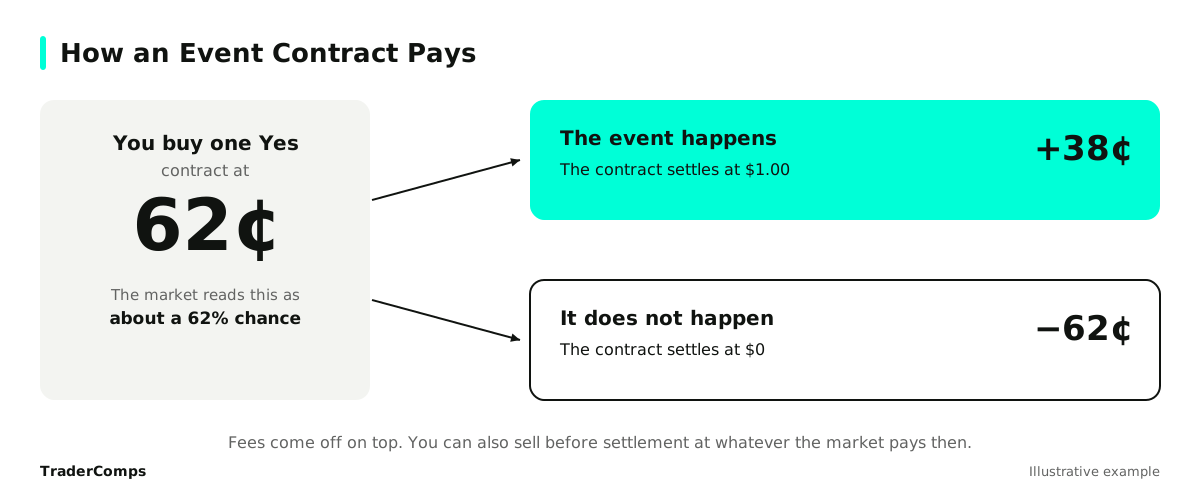
You do not have to hold to the end. You can sell contracts before a market closes at the price another trader will pay, with a quick order or a limit order (Kalshi). If you hold to settlement, a winning contract pays $1 into your cash balance and a losing one pays nothing. Kalshi states plainly that members can lose their entire investment, including fees (Kalshi).
The Fee Formula
Kalshi earns a transaction fee on the expected earnings of each contract (Kalshi). Its fee schedule, effective 7 July 2026, sets the general taker fee as (Kalshi fee schedule):
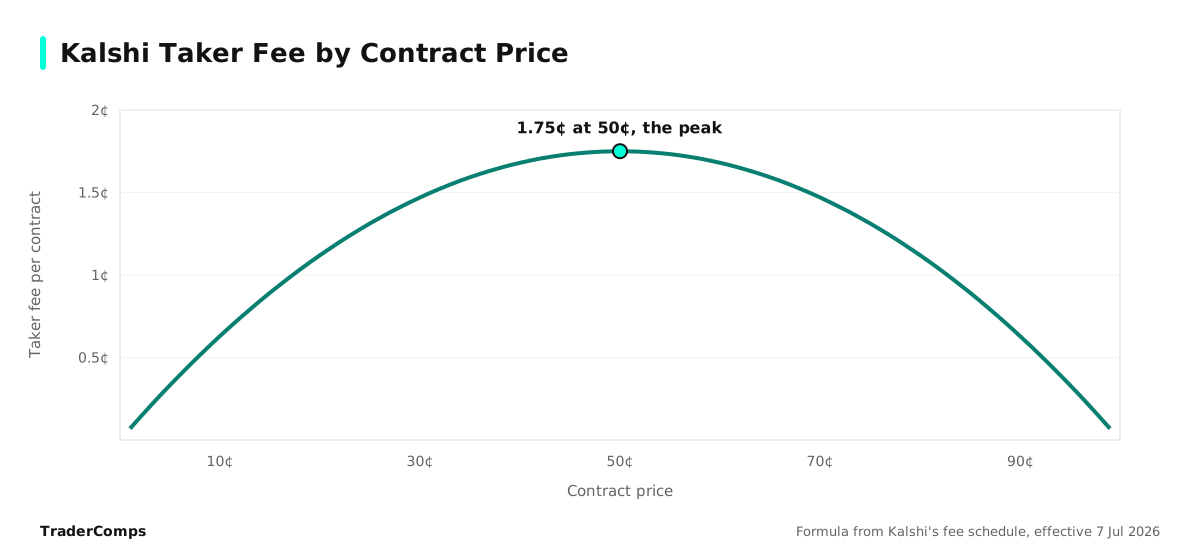
fees = round up(M × 0.07 × C × P × (1 minus P))
Here P is the contract price in dollars (50 cents is 0.5), C is the number of contracts and M is a multiplier, 1 unless a market says otherwise. Maker fees, charged when a resting order fills, use 0.0175 in place of 0.07, but their multiplier defaults to 0, so most markets charge makers nothing. Cancelling a resting order is free, and there is no settlement fee. Some series carry their own rates, which the schedule lists. The fee is rounded up; Kalshi's API documentation explains how rounding works and when overpayment is rebated (Kalshi docs).
Because P × (1 minus P) peaks at 0.25, the fee is highest at 50 cents. As a share of what you spend, though, it is heaviest on cheap contracts. For 100 contracts bought as a taker:
| Price per contract | Cost of 100 contracts | Taker fee | Fee as share of cost | Profit if right, after fee |
|---|---|---|---|---|
| 10 cents | $10.00 | $0.63 | 6.3% | $89.37 |
| 30 cents | $30.00 | $1.47 | 4.9% | $68.53 |
| 50 cents | $50.00 | $1.75 | 3.5% | $48.25 |
| 70 cents | $70.00 | $1.47 | 2.1% | $28.53 |
| 90 cents | $90.00 | $0.63 | 0.7% | $9.37 |
The formula applies to each trade, so selling before settlement as a taker is a second fee. If you are wrong, you lose the full cost plus the fee. Polymarket uses the same price × (1 minus price) shape with rates that vary by category (Polymarket); our Polymarket vs Kalshi comparison works through both.
Deposits and Withdrawals
Kalshi takes debit cards (including Apple Pay and Google Pay), bank transfer (ACH), PayPal, Venmo, Cash App for deposits only, crypto and wire. The standard minimum deposit is $10 (Kalshi).
| Method | Deposit fee | Withdrawal fee | Notes |
|---|---|---|---|
| Debit card | May incur 2% | None | Withdrawals usually arrive within a few hours (deposit, withdrawal) |
| Bank transfer (ACH) | None | None | US only; deposits settle within 5 business days (deposit, withdrawal) |
| Wire | None | Not stated | $1,000 minimum; no withdrawal hold (Kalshi) |
| Crypto | Not stated | None | Withdrawal needs a prior crypto deposit; usually within 30 minutes (Kalshi) |
Outside the US, deposits are limited to debit card, crypto and wire, and withdrawals to debit card and crypto. Card and ACH deposits can be withdrawn by the same method once they settle, or up to two days later by a different method; profits beyond your deposit can be withdrawn once settled (Kalshi). Eligible US accounts holding $250 or more earn interest, at a variable 3.50% when we checked (Kalshi).
Who Can Sign Up
You must be 18 or older, and you are responsible for checking that using Kalshi is lawful where you are (Kalshi). Kalshi verifies every account: you give your name and date of birth to match a driver's licence or passport, and you may be asked for a Social Security Number, proof of address, employment details or source of funds (Kalshi).
Kalshi says you can trade from many countries outside the US, with restricted jurisdictions set out in Section VI of its Member Agreement (Kalshi). Read that list before you open an account.
Inside the US, Kalshi's position is that it is legal in every state, Washington DC and US territories (Kalshi). States dispute this, mainly over sports. In August 2026 Kalshi itself counted twenty states in active litigation over prediction markets (Kalshi). In April 2026 the CFTC sued Arizona, Connecticut and Illinois to assert its exclusive jurisdiction over event contracts (CFTC), and in June 2026 it proposed a framework for reviewing contracts that involve gaming or other listed activities (CFTC). The rules can change by state and by market, so check the position where you live.
How Markets Settle and Who Decides
Each market's rules state how the outcome is decided and which source is used. After a market closes, Kalshi's team sets the result from that source agency, which Kalshi says takes from one hour to more than twelve (Kalshi). Most markets settle within about three hours of the outcome being known, and winnings go to your cash balance (Kalshi).
Kalshi's API documentation shows the steps: a market closes, is "determined", then runs a settlement timer during which the result can be disputed and, if needed, determined again before payouts are final (Kalshi docs). Read the rules of a market before you trade it: the wording of the question and the named source decide your payout, not the headline.
Kalshi Offers and Campaigns on TraderComps
Kalshi runs a referral program for eligible US users. Its help centre says amounts vary by offer, "up to" figures are maximums, and credits may carry withdrawal restrictions until you trade them (Kalshi). It also runs liquidity incentive programs on selected markets for set periods, and may end a program at any time (Kalshi).
TraderComps lists no Kalshi campaign as at 12 October 2026. The prediction market listings we hold are Limitless's Points Season 4, which runs to 26 October, and Polymarket's perps launch, which carried no published reward. Our guide to points programs and airdrops explains why points are not a promised reward.
By scale, Kalshi leads the prediction markets in our rankings on 30-day volume. When our data last refreshed (11 October 2026, UTC), DefiLlama showed about $459 million of 24-hour volume, $13.0 billion over 30 days and $1.82 billion of open interest. Our guide on how to read trading volume and open interest explains what those figures do and do not tell you. Kalshi also offers bitcoin perpetual futures to US residents with up to 6x leverage (Kalshi), a separate product with its own fees and liquidation risk.
Before You Start
- Confirm you are 18 or older and that your country or state is not excluded.
- Have your ID ready, and expect to be asked for more documents.
- Pick a funding method with its fee and hold in mind: ACH and wire carry no deposit fee, a debit card may cost 2%.
- Work out the taker fee at the price you plan to pay, and remember a sale before settlement pays it again.
- Read each market's rules and named source before you trade.
- Read the full terms of any referral offer, including withdrawal restrictions.
- Only stake money you can afford to lose in full.
- Practise first if you like: Kalshi runs a demo account with mock funds (Kalshi).
For a wider check of any offer, see how to check a trading campaign before you join, and the Kalshi venue profile for fees and live figures.
This guide is information, not financial advice. Trading event contracts carries risk, and Kalshi's fees, rules and availability change: check its own pages before you trade.
Questions and answers
How does Kalshi work?
Kalshi is a CFTC-regulated exchange where you buy yes or no contracts on the outcome of events. Prices run from 1 to 99 cents and move with what traders expect. A contract that ends on the right side pays $1, and the other side gets nothing. You trade against other members, not against Kalshi, and Kalshi earns a fee on each trade rather than on the result.
How much are Kalshi's fees?
Kalshi's published taker fee is 0.07 multiplied by the number of contracts, the price and one minus the price, rounded up. It is largest at 50 cents: 100 contracts at 50 cents cost $1.75 in fees. At 10 or 90 cents the same order costs $0.63. Maker fees apply only on markets that set a maker multiplier, which is zero by default, and there is no settlement fee.
Who can open a Kalshi account?
Kalshi requires account holders to be 18 or older and to pass identity checks. You give basic personal details and may be asked for a driver's licence or passport, a Social Security Number, proof of address or source of funds. Kalshi says it is open in many countries outside the US, with excluded jurisdictions listed in its Member Agreement, and it leaves checking local legality to each trader.
Who decides how a Kalshi market settles?
Each Kalshi market's rules name the source used to decide it, such as a government data release or official league statistics. Once the market closes, Kalshi's markets team sets the result from that source. Kalshi says this takes from one hour to more than twelve hours. Its API documentation shows a settlement window in which a result can be disputed and, if needed, determined again.
Does Kalshi have a sign-up bonus?
Kalshi runs a referral program for eligible US users. Its help centre says amounts vary by offer, that figures shown as up to an amount are maximums, and that credits can carry withdrawal restrictions until traded. TraderComps lists no Kalshi campaign at the time of writing. Read the terms linked in any offer before you deposit, and treat a bonus as uncertain until it is credited.
Live Campaigns Related to This
Coinstore
Crypto exchanges
MNR Invite & Plant: Share 1,000U Worth $MNR
666 MNR (stated as worth 1,000 USDT)
Time left
5 days
Score
Not rated
To join
Medium
Referral · Crypto
FTMO
Prop firms
FTMO Futures launch competition (partners)
Up to 10 FTMO Futures Pro 100K accounts for first place
Time left
6 days
Score
Not rated
To join
High
Referral · Futures · Global, FTMO partners only
Limitless
Prediction markets
Points Season 4
Points toward the future Limitless token airdrop
Time left
14 days
Score
Not rated
To join
Medium
Points season · Event contracts · Excludes US + more · Token live: LMTS