
Guide
What Is a Prop Firm, and How Do Prop Firms Make Money?
What is a prop firm: how evaluations, fees, profit splits and payouts work, whether funded accounts are simulated, and how prop firms make money.
 By Julian Stafford, Co-Founder, Surgence Labs · 11 Oct 2026 · 8 min read
A prop firm is a company that lets you trade an account it provides and pays you a share of the profits. The retail prop firms most traders meet today make their money mainly from the fees traders pay to qualify, and at many of them the funded account is simulated rather than live capital. This guide explains how the model works, what each firm's own terms say, and what is on offer as at 12 October 2026.
What Is a Prop Firm
"Prop" is short for proprietary. A traditional proprietary trading firm trades its own money through its own staff and keeps the profits. The name now also covers a different business sold to the public: the funded trader programme.
In that model you buy an evaluation, often called a challenge. You trade under a profit target and loss limits. Pass, and you get a funded account where the firm pays you a share of the profits you make on it. Our guide to how prop firm challenges work covers the rules of the test in detail. This page covers the business behind it.
How Prop Firms Make Money
A retail prop firm has several income lines, and most of them are paid by traders before any trading happens.
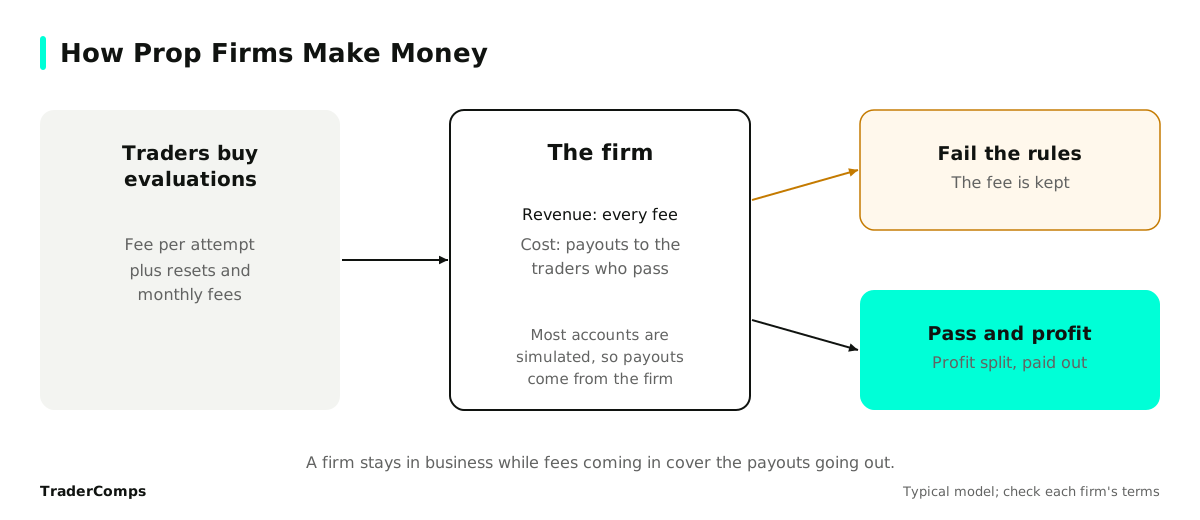
- Evaluation fees. The price of one attempt. FTMO's 1-Step Challenge runs from €79 for a $10K account to €999 for $200K (FTMO). FTMO's US site says the fee covers access to the evaluation, its client area, trading apps, education and support (FTMO US).
- Subscriptions and activation fees. Topstep charges $49, $99 or $199 a month for its 50K, 100K and 150K Trading Combine on the Standard Path, plus $149 once per Express Funded Account earned. A reset costs the same as the monthly price (Topstep).
- Paid add-ons. Kraken Prop defaults to an 80% split and charges 20% more on the base plan price for 90% (Kraken). SizeProp sells 90% and 95% splits as upgrades on an 80% default (SizeProp).
- Trading and data costs. Topstep deducts commissions from your balance with each trade and charges $38 a month for Level 2 market data.
- The firm's share of profits. On an account that pays out, the firm keeps the part of the profit you do not, often 10% to 20%.
On a simulated account, no profit is made in the market. The reward is paid from the firm's own income, and the largest visible part of that income is what traders pay to take part. The model works because many people pay for attempts and few reach a payout. Firms rarely publish revenue breakdowns, so treat any precise split you see quoted elsewhere with care.
Firms also pay to find customers. FTMO's Futures launch competition for partners ranks affiliates by the number of paid FTMO Futures accounts their referrals open.
Simulated or Live Capital: What the Terms Say
"Funded" does not always mean real money. The table sets out what each firm's own pages say, in alphabetical order.
| Firm | Markets | How you pay | Trader's share | Funded account, in the firm's words |
|---|---|---|---|---|
| FTMO | Forex, commodities, indices, futures | One-off fee | 80% on 2-Step, 90% on 1-Step (FTMO) | All accounts are demo accounts with fictitious funds (FTMO) |
| FundedNext | Forex, commodities, indices, futures | One-off fee | Up to 90% CFD, up to 100% futures | "Simulated funded account" (FundedNext) |
| HyroTrader | Crypto | One-off fee or refundable deposit, from $59 (HyroTrader) | 80%, rising to 90% on One- and Two-Step | Simulated, with no real-capital stage at any point (HyroTrader) |
| Kraken Prop | Crypto | One-off fee, $20 to $1,090 (Kraken) | 80% default, 90% as a paid option | Evaluation on a simulated balance, then funded capital provided through the programme (Kraken) |
| The5ers | Forex, commodities, indices | One-off fee, from $19 on High Stakes (The5ers) | From 80%, scaling toward 100% | Evaluation funds are fictitious; the terms do not say whether the later stage is live (The5ers) |
| Topstep | Futures | Monthly subscription plus activation fee | 90% | Express Funded Account is simulated; a Live Funded Account trades live markets with Topstep's capital (Topstep) |
Where an account is simulated, your payout is a reward under a contract, not a share of real trading gains. That makes the firm's ability and willingness to pay the thing you are relying on.
Payout Rules
The profit split is the headline. The payout rules decide what you actually receive.
- Timing. FTMO lets you request a reward on the 14th day after your first trade, with all positions closed, then reviews it in one to two business days (FTMO). Kraken Prop says payout reviews typically take under 12 hours and are guaranteed within 24.
- Caps and instalments. The5ers' terms say approved payouts above a threshold it sets are paid in weekly instalments of up to $10,000 (The5ers). HyroTrader's free sponsored accounts allow one payout, capped at 5% of the starting balance, after which the account closes.
- Conditions. Identity checks, closed positions, minimum amounts and consistency rules all sit between a profitable account and money in your bank. FTMO, for example, sets minimum withdrawals of $20 by bank wire and $50 in crypto.
Read the payout terms before you buy, not after you pass.
Why Most Traders Fail Evaluations
Few firms publish pass rates. Topstep does. For 2025 it says (Topstep):
- 16.8% of all Trading Combines started were completed.
- 51.8% of participants who started one or more Combines passed at least one.
- 33.3% of participants at the funded level received a payout.
- 0.71% of participants trading an Express Funded Account were called up to a Live Funded Account.
Topstep notes these figures cover both simulated and live trading and do not indicate future results. For firms that do not publish their own figures, we do not quote one. Our challenge guide sets out the industry data that has been reported.
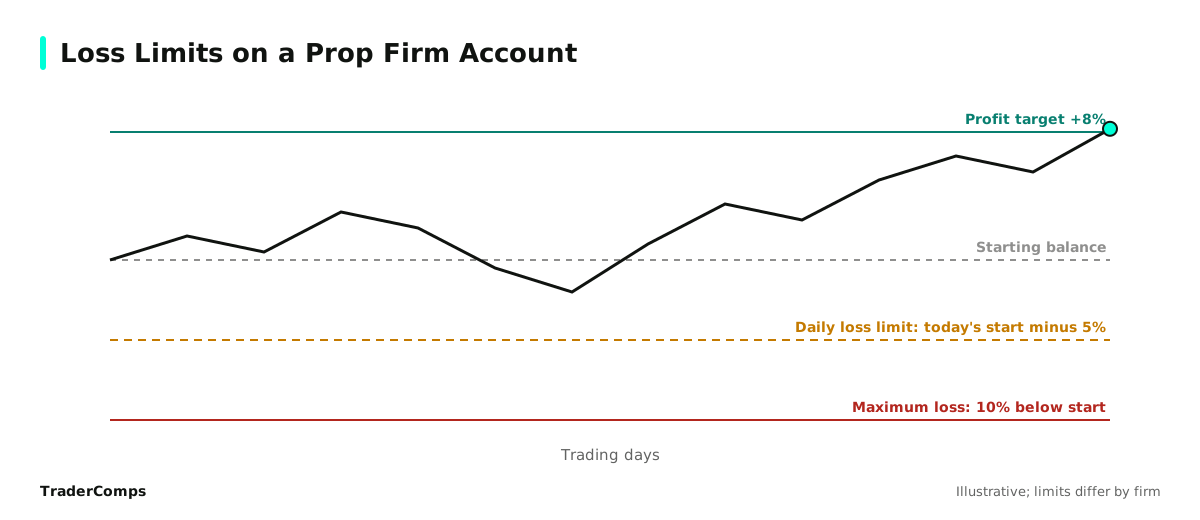
The rules explain much of it. A daily loss limit can end an account in one bad session. A trailing drawdown rises with your highest balance, so a profit followed by a pullback can fail you. Consistency rules cap how much one good day can count. Each attempt has a fee, so a run of resets can cost more than any payout you later earn.
Futures vs Forex, CFD and Crypto Prop Firms
Futures prop firms mirror exchange-listed contracts such as index and commodity futures. Topstep is futures only. Costs include a subscription, per-trade commissions and paid data, and trading follows exchange session hours. FTMO and FundedNext now sell futures accounts too. See futures campaigns.
Forex and CFD prop firms offer contracts for difference on currencies, metals, energy and indices, usually for a one-off fee. FTMO, FundedNext and The5ers sit here. Costs show up as spreads and overnight swaps. See forex campaigns.
Crypto prop firms run evaluations on crypto pairs and often pay in stablecoins. Kraken Prop runs inside Kraken Pro with up to 5x leverage, while HyroTrader connects Bybit or BloFin demo accounts or its own terminal and pays in USDT or USDC (HyroTrader). See crypto campaigns.
Are Prop Firms Regulated
Most retail prop firms are not regulated as brokers, and we have not recorded a financial regulator for any prop firm in our venue directory. Some say so in their own words: Vanta Trading says it is a technology provider that does not provide financial services (Vanta Trading), and SizeProp says it provides simulated trading services only (SizeProp).
Regulators have tested the model. In 2023 the US CFTC charged My Forex Funds, alleging it was the counterparty to substantially all customer trades and had taken at least $310 million in fees from more than 135,000 customers (CFTC). In 2025 the court found the CFTC had acted in bad faith and sanctioned it (CFTC), and the case was dismissed (Finance Magnates). Your protection is the firm's terms and its record of paying.
Prop Firm Campaigns on TraderComps Now
These are the prop firm offers we list as at 12 October 2026, ordered by end date. Each links to our listing and the firm's own page.
- Ends 15 October. FundedNext's free October 2026 monthly competition: highest equity at the close wins, with $8,000 cash plus funded accounts for 760 winners. It works like a demo contest, explained in how trading competitions work.
- Ends 18 October. FTMO's Futures launch competition, for FTMO affiliates only.
- Ends 31 October. Vanta Trading's Oktoberfest sale: 20% off $25K, $50K and $100K evaluations and Instant Funded with code OCT20.
- No end date shown. FTMO's 20% off the $100K 1-Step Challenge, SizeProp's 10% off evaluations with code IGLOO, and HyroTrader's Sponsored Challenge Program of up to 100 free evaluations a month for experienced traders.
A discount lowers the cost of an attempt. It does not change the odds of passing. See every firm on Prop firms and all price cuts on Fee discounts.
Before You Start
- Read the firm's own terms and find the sentence that says whether the funded account is simulated or live.
- Price every cost: fee, resets, activation, subscription, commissions and data.
- Read the payout rules: first payout date, caps, instalments, minimums and identity checks.
- Check the refund policy for the exact product you are buying.
- Confirm your country is accepted.
- Look for published pass and payout figures, and treat their absence as information.
- Set a limit on how many attempts you will pay for.
Our checklist on how to check a trading campaign before you join covers sources, dates and terms step by step.
This guide is information, not financial advice. Trading carries risk, prop firm fees are usually lost if you fail, and every offer's terms are set by the firm.
Questions and answers
What is a prop firm?
A prop firm, short for proprietary trading firm, traditionally trades its own capital through its own staff. The retail prop firms most traders meet today sell an evaluation instead: you pay a fee, trade an account under set loss limits and a profit target, and if you pass you trade a funded account and keep a share of the profits. At many of these firms the funded account is simulated.
How do prop firms make money?
Retail prop firms make most of their money from what traders pay to take part: one-off evaluation fees, monthly subscriptions, resets, activation fees and paid add-ons such as a higher profit split. On accounts that pay out, the firm also keeps its share of the profits, often 10% to 20%. Because most traders do not reach a payout, fees from many attempts fund the rewards paid to a few.
Do prop firms give you real money to trade?
Often they do not. FTMO states that all its accounts are demo accounts with fictitious funds, and HyroTrader says there is no real-capital stage at any point. Payouts are rewards calculated from simulated results. Some firms describe a live stage: Topstep can call traders up from its simulated Express Funded Account to a Live Funded Account. Read each firm's own terms before you buy.
What percentage of traders pass a prop firm challenge?
Few prop firms publish pass rates. Topstep is an exception: it says 16.8% of Trading Combines started in 2025 were completed, 51.8% of participants passed at least one, and 33.3% of participants at the funded level received a payout. It also says 0.71% of Express Funded Account traders were called up to a Live Funded Account. Without a firm's own figures, assume most attempts fail.
What is the difference between a futures prop firm and a forex prop firm?
A futures prop firm mirrors exchange-listed futures, and a forex or CFD prop firm offers contracts for difference on currencies, commodities and indices. Costs differ: Topstep charges a monthly subscription, deducts commissions per trade and sells Level 2 data, while FTMO, FundedNext and The5ers mostly charge a one-off fee per challenge. Futures accounts follow exchange session hours, while CFD accounts carry spreads and overnight swaps.
Live Campaigns Related to This
FundedNext
Prop firms
October 2026 monthly competition
$8,000 cash plus $1.21M in funded accounts
Time left
3 days
Score
5/5
To join
Low
Demo contest · Forex, Commodities +1 · Global (some countries excluded)
BingX
Crypto exchanges
Derive (DRV) Listing: Limited-Time Zero Fee
0% trading fee on DRV/USDT
Time left
5 days
Score
Not rated
To join
No minimum
Fee discount · Crypto · Excludes US, UK, CA + more
Coinstore
Crypto exchanges
MNR Invite & Plant: Share 1,000U Worth $MNR
666 MNR (stated as worth 1,000 USDT)
Time left
5 days
Score
Not rated
To join
Medium
Referral · Crypto