
Guide
How Prop Firm Challenges Work
How prop firm evaluations, drawdown rules, profit splits and fees work, how many traders get paid, and what to check before you buy a challenge.
 By Julian Stafford, Co-Founder, Surgence Labs · 11 Oct 2026 · 6 min read
A retail prop firm sells you an evaluation: you pay a fee, trade an account under strict rules, and if you pass you get an account where the firm pays you a share of the profits. At many of these firms the accounts are simulated, and challenge fees are a core part of how the firm earns money. Published data suggests most people who buy a challenge never receive a payout.
What a Prop Firm Is
A proprietary trading firm, in the traditional sense, trades its own capital through its own staff. The firms marketed to retail traders today work differently. You pay for a test, and passing it earns you a funded account with a profit share.
That funded account is often not live capital. FTMO, for example, states that all accounts it provides are demo accounts with fictitious funds and that trading takes place in a simulated environment only (FTMO). Your payout is a reward calculated from simulated results. Some firms describe a path to live capital: Topstep presents its Express Funded Account as a step toward it.
Types of Challenge
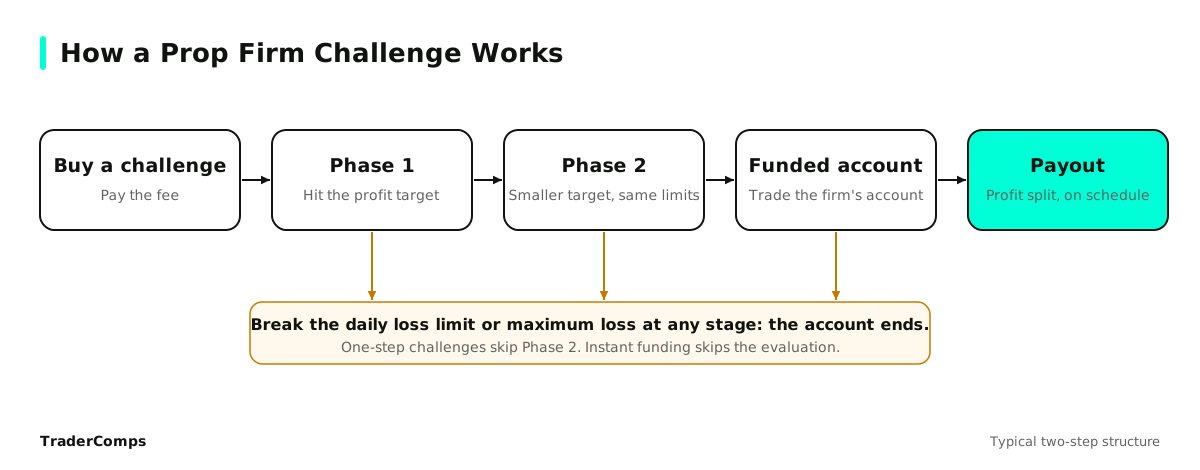
- Two-step. Two phases, each with a profit target. FTMO's 2-Step asks for 10% in the Challenge and 5% in the Verification, within a 5% maximum daily loss and a 10% maximum loss, over at least four trading days (FTMO).
- One-step. One phase. FTMO's 1-Step asks for 10% with a tighter 3% maximum daily loss and a trailing 10% maximum loss (FTMO).
- Instant funding. You skip the test and start on a funded account straight away, under that account's own rules. FundedNext's October monthly competition awards Stellar Instant accounts as prizes.
- Subscriptions. Some futures firms charge monthly instead of once. Topstep's Standard Path costs $49, $99 or $199 a month for 50K, 100K or 150K accounts, plus a one-time $149 activation fee per Express Funded Account.
Free contests also exist. FundedNext's monthly competition costs nothing to enter, ranks on highest equity at the close, and needs at least five trading days to rank.
Common Rules
Every firm writes its own rulebook, but the same terms appear again and again.
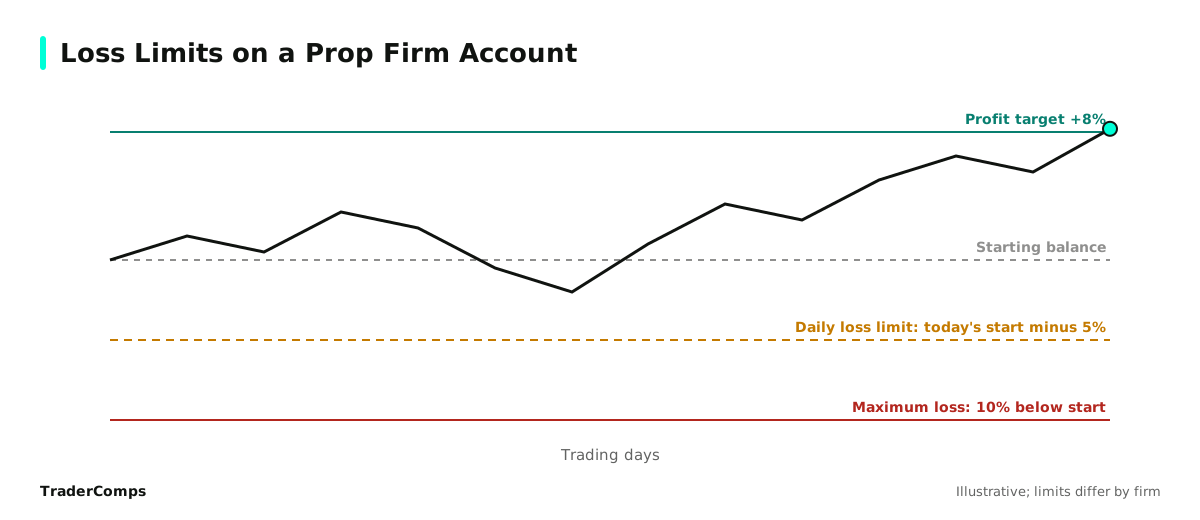
- Profit target. The gain you must reach to pass a phase, usually set as a percentage of the starting balance.
- Daily loss limit. The most you can lose in one day. Break it once and the account usually fails.
- Maximum drawdown. The most the account can fall overall. A static limit is measured from the starting balance. A trailing limit follows your highest balance up, so profits raise the floor. FTMO's 2-Step uses a static limit and its 1-Step an end-of-day trailing one. Topstep's Trading Combine has one rule: do not let the balance hit or go below the Maximum Loss Limit (Topstep).
- Minimum trading days. A floor on how many days you must trade, such as four on the FTMO 2-Step.
- Consistency rules. Limits on how much of your profit one day can provide. FTMO's 1-Step requires that your strongest day is no more than 50% of your positive days' profit. Topstep sets a consistency target against its profit target.
- News trading. FTMO allows trading through news during the evaluation, but on a Standard FTMO Account you cannot open or close trades from 2 minutes before to 2 minutes after selected releases (FTMO).
Also check the rules on holding over weekends, automated strategies, copying trades between accounts and how many accounts you may run.
CFD and Futures Prop Firms
CFD prop firms let you trade forex, commodities and indices through contracts for difference. FTMO, FundedNext and The5ers sit here. Fees are usually one-off: FTMO's 1-Step runs from €79 for $10K to €999 for $200K, and The5ers' High Stakes runs from $19 for 2.5K to $405 for 100K.
Futures prop firms mirror exchange-listed futures. Topstep is the clearest example: a monthly subscription, commissions and exchange fees deducted per trade, and paid market data as an extra. FTMO has also launched FTMO Futures accounts.
The difference matters for costs and rules. Futures accounts carry per-trade commissions and session hours, while CFD accounts carry spreads and overnight swaps.
Profit Splits and Payouts
The split is the share of profits you keep. FTMO advertises up to 90%, FundedNext up to 95%, Topstep 90%, and The5ers starts at 80% and scales toward 100% as the account grows.
The split matters less than whether a payout happens at all. Payouts can come with their own conditions, such as minimum profitable days, waiting periods, identity checks and caps. Read them before you buy, not after you pass.
Fees, Discount Codes and Refunds
The fee is the price of one attempt. Fail, and a new attempt or a reset costs again.
Discounts are common. FTMO's site advertised 20% off its $100K 1-Step Challenge with no end date or code shown, so it could be withdrawn at any time. A discount lowers the cost of an attempt. It does not change the odds of passing.
Refund policies differ even within one firm. FTMO says the 1-Step entry fee is not refunded, while the 2-Step fee may be refunded with the first reward withdrawal (FTMO).
Most Traders Do Not Pass
The numbers available point the same way.
- Data from FPFX Technologies, covering more than 300,000 accounts from 100,000 traders at 10 firms, showed 14% of traders passed and obtained a funded account, and about 7% of all traders received a payout. The average payout was 4% of the plan size, and the average trader spent $800 on challenges (Finance Magnates).
- The CEO of The Funded Trader said 5% to 10% of its clients pass, and about 20% of those who pass receive payouts (Finance Magnates).
This is the business model, not a flaw in it. Fees from the many attempts that fail pay for the rewards of the few that succeed. Treat a challenge fee as money spent, not money deposited.
Regulation Status
Most retail prop firms are not regulated brokers. They sell an evaluation service and a profit-share agreement, and with simulated accounts they do not hold your money for trading. We have not recorded a financial regulator for any prop firm in our venue directory.
The legal position is unsettled. In the US, the CFTC's 2023 case against the parent of My Forex Funds was dismissed with prejudice in 2025, and the court sanctioned the regulator (Finance Magnates). In practice, your protection is the firm's own terms and its record of paying.
Checklist Before You Buy a Challenge
- Read the full rules on the firm's own site, including the payout terms.
- Check whether the funded account is simulated or live.
- Note the profit target, daily loss limit and whether the drawdown is static or trailing.
- Look for consistency, news, weekend and minimum day rules.
- Confirm your country is accepted and what identity checks apply at payout.
- Price the full cost: fee, resets, activation fees, subscriptions, commissions and data.
- Check the refund policy for the exact challenge you are buying.
- Decide in advance how many attempts you will pay for, and stop there.
Compare current challenge offers on TraderComps, or see every firm we track on Prop firms.
This guide is information, not financial advice. Trading carries risk, and campaign terms are set by each venue.
Live Campaigns Related to This
Upbit
Crypto exchanges
KAIA/KRW Zero Trading Fee Event
0% trading fee on KAIA/KRW (from 0.05%)
9 Oct to 11 Oct
Ends today
FundedNext
Prop firms
October 2026 monthly competition
$8,000 cash plus $1.21M in funded accounts
1 Oct to 15 Oct
4 days left
BingX
Crypto exchanges
Derive (DRV) Listing: Limited-Time Zero Fee
0% trading fee on DRV/USDT
10 Oct to 17 Oct
6 days left